
Presentation by Uncle Bob
Robert C. Martin gave a nice presentation on InfoQ, highly recommended.
Robert C. Martin gave a nice presentation on InfoQ, highly recommended.
Yesterday I watched Food Inc. documentary movie. And this morning, hours after watching it, on the radio they announce salads recall – Salmonella bacteria contamination. Wonderful. Another proof of house mass production (and not just food) can go and goes wrong. The movie is highly recommended.
Nice to see BDD spreading quickly around. Reminds me how about two ago I wanted to switch our company from ASP.NET web forms to MVC, to allow better introduction into testability. This video just reminded me how correct that assumption was. And these days, with the tools like MSpec and support out of box by R# and VS.NET – it’s a must. Enjoy the video.
PS: one thing I didn’t like in particular, if you talk about mocking, show it, don’t just leave it in words. Otherwise it’s a bad service for novice that want to see it in action.
Buy vs. Build dilemma is quite common in software development. Based on degree of customization, decisions are made. But is it just degree of customization? As a developer, the urge to build and will to prove that “we can pull it off” is very strong. What I find often is that another dilemma exists, similar to the mentioned one, but rooted in restrictions related to time and will to go above the “regular known” – Learn vs. Build.
This is an interesting plug-in for VS.NET 2008/2010 to allow remote pair-programming. I’m a big advocate for pair-programming and collaborative work, so this plug-in has its place in the real world. I used to pair-program with a developer that was remote, and we used VNC/RDC, but this one is way better.
I have run into this issue trying to add custom pipeline component to toolbox. The only way (I know about) to add a custom pipeline component to a customized pipeline is using the visual designer. In order to do that you have to have components on toolbox. This was a bit frustrating. Google has brought one result which was exactly what I needed. One of the comments had another link, to the similar issue, but this time with a different title: Hotfix for BizTalk 2009 and Visual Studio 2008. I followed the link, installed hotfix, and it worked. Oh, yes, you have to reboot your machine for hotfix to work completely (this is where I spent some time pulling my hair out and asking why hotfix didn’t work?!). Once this is done, you are good to go.
Time saving project to generate BizTalk Server Pipeline Components.
ESB Toolkit Extensions is an open-source library giving you an extended BRE/BRI provider to read and write promoted properties of a message within business rules engine. I’ve used it to achieve automated process for mapping to canonical schema and then back to destination schema based on receiver ID as a promoted property (will blog on this later). A very useful library!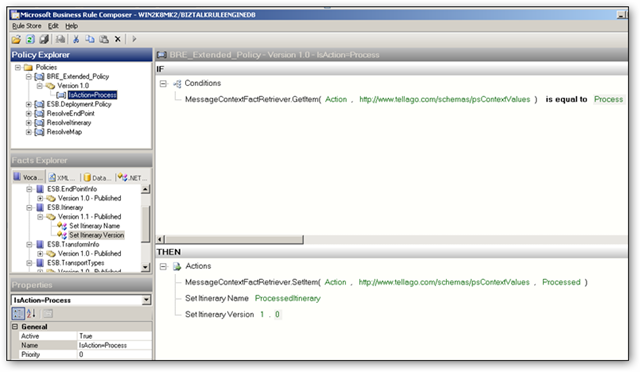
Here I am shouting again about the fact that we are looking for good developers. Our team has matured, and now definition of a “good developer” is not what we used to think of it before. Don’t misunderstand me, we are looking from smart people, but also rounded people.
Our team has shrunk by one developer, whom ironically I welcomed aboard a little more than a year ago. Life is life, and things are dynamic. I wish him good luck, and hope to see the replacement coming soon.
A X509 Certificate is required in the model property ‘EncryptionCertificate’ to encrypt any sensitive property in the designer.
By design, Itinerary designer requires a certificate to save a newly created itinerary. This is required to encrypt “sensitive” data. What if you don’t have that kind of data, or not willing to use certificate? There’s an option to disable designer from requesting the certificate described in linked post, as well as how properly to use one in case it’s needed.